Age : 2500 years
Population : 5 Million
Temperature : Min 16°C – Max 34°C
Location : Latitude 16° 47′ N, Longitude 96° 08′ E
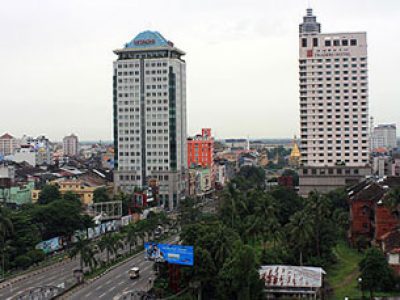
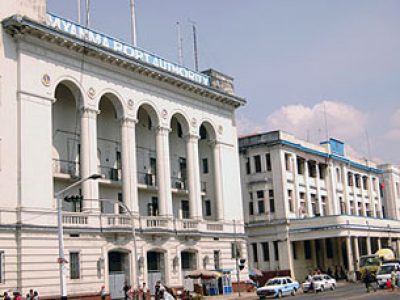
The history of Yangon is intertwined with the history of the Shwedagon Pagoda. Wherever one may be in Yangon, in the busy town center, in the new towns of the east, in the industrial zone of the west, in the paddy fields of the north, the golden form of the Shwedagon will be seen on the skyline rising above the foliage of the tropical trees, and the top of high rises. The founding story of Shwedagon reaches back to the days of the Enlightenment of Gaudama Buddha when He discovered the cause of universal suffering and the way to its elimination.
It was on the 49th day after the Enlightenment when two brothers, Taphussa and Bhallika, merchants from Ukkalapa in the land of Mon people in Lower Myanmar, came before Buddha. A nat (spirit) who had been the mother of the two brothers in a previous existence had guided them to the Buddha. The brothers offered honey cakes. After Buddha had eaten the cakes, the brothers asked for gift. Buddha passed His hand over His head and, obtaining eight Hairs, gave them to the brothers. Buddha, perceiving that the three previous Buddhas had caused their possessions to be enshrined in a pagoda on Singuttara hill in the country of the two brothers, bade them to do likewise with the Sacred Hairs.
The brothers returned home and made landfall at Pagoda Point in the south-west coast of Myanmar. They sent word to king Ukkalapa of their arrival with the sacred Hairs. The King welcomed the Hairs with great ceremony at Asitanzana, north-west of present Yangon.
The king and the brothers next sought for a man who could tell them the location of Singuttara Hill. No human knew the location but Sakka, King of the nats did, and guided them to the Hill. Singuttara Hill is known by seven names of which one is Trikhumba, meaning ‘three pots’ and signifying three pot-shaped hills. Tikhumba became Tikun and Dagon and later Changed to Lagun in Mon.
When the brothers asked Sakka where the Hairs should be shrined, Sakka could not tell them where the earlier relics were enshrined because they were of such antiquity and he was not that old. However, Sule Nat knew where Kakusandha Buddha’s staff was enshrined, Yawhani Nat knew where Konagamana Buddha’s water-dipper was enshrined. Hmawbi Nat revealed that he had been assigned to guard the sacred objects. Finally, Gautama Buddha’s Hairs were enshrined and stupa consecrated on the full moon day of Tabaung (March 6,c.588 B.C.). A long time after that, there that, there being no one to worship at the Lagun shrine, it fell into ruin and was covered with jungle.Tradition states that 200 years after Buddha’s Parinirvana in 543 BC. Sona and Uttara, two monks from Sri Lanka brought King Asoka to the Pagoda. The King had the jungle cleared and the Pagoda repaired. In the fifth century A.D. King Duttabaung paid homage at the Pagoda. In the 11th century, King Anawratha of Bagan offered gold and silver umbrellas and built a pagoda near the town of Twante across the Yangon River. Dalla, which is now a town on the bank opposite Yangon, was then located on the Twante Ridge and was more important than Dagon. Dagon at that time lay in low lying often water-logged land. Sule Pagoda, now in downtown Yangon, stood on a small island in the swamp, to the west down to he Hlaing River and Yangon /River to the south .The Shwedagon (then called Kyak Lagun in Mon) was reached across a causeway.
The discovery of a votive of the Bagan period at Tadagale to the north of Yangon shows that the laterite ridge at the end of which Shwedagon lay was a scene of activity in the Bagan period and the ridge may have provided a road southwards to the Shwedagon Pagoda and Dagon Village beyond. After the collapse of Bagan in the 13th century and the rise of Mon power in the 14th with the capital at Bago, Dagon became a place of some importance, though not as a commercial port but as a centre of religious life. At onetime Dagon was reported to contain thirty-two ordination halls Binnya U (1348-83), Mon king of Bago created a pagoda of height 18 m. (60′). Dagon was also a place of refuge for princes who did not find Bago safe. Binnya U’s son, Binnya Nwe, later King Rajadarit, who had a chronicle to himself, fled to Dagon when he ran away with his half-sister Talamidaw. Dagon at that time was not a walled city but a fort of logs. Successive Mon King of the 15th century raised the height of Pagoda by encasing earlier pagoda and embellishing the new. King Binnyayan (1426-46)cut down the hill and enlarged the base to five terraces to sustain the height but before he could finish the work he died. The work was continued by his successor, Binnyawaru (1446-50) who was helped by his mother, Queen Shin Saw Bu, the only regnant queen of Myanmar. She was ably assisted by the commander of the army, soldiers, attendants and the common people. They raised the height of the Pagoda to 90.6 m(302′). Queen Shin Saw Bu was the first to gild the Pagoda. She went on the scales and let them take her weight which was a bout 40 kg.(90 lbs). She donated that weight in gold. She dedicated a vast expanse of glebe lands which virtually covered the whole of modern Yangon. Her successor King Dhammazedi created the stone inscriptions standing on Pagoda Hill. He also donated a huge bell which a Portugese adventurer took away but which fell into the river and has not been recovered.
In 1539, Tabinshwehti, who had conquered Bago, placed a jewelled finial on the Pagoda.
Casper de Cruz, a Dominican priest, who was the country between 1550-60 said that “the Brames (Burmese) were a great people, very rich of gold and precious stones, chiefly of rubies; a proud nation and valiant. They have very rich and gallant shippings garnished with gold which they sail in the rivers; they use vessels of gold silver; their houses are of timber and well wrought. The kingdom is very great.”
In 1572, Bayinnaung rebuilt the Pagoda to 360′ and had it reguilded. The shrine had been reduced to rubble during an earthquake in 1564.Bayinnaung embarked from Bago in a golden barge in the form of the mythical hintha bird, surmountedby a golden spire. The barge was escorted by a large fleet of 300 golden canoes and 1000 war boats which filled the Bago River as far as the eye could see. The grand fleet floated down to Dagon. Bayinnaung repeated the trip in 1581.
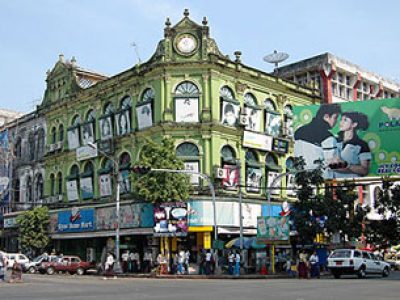
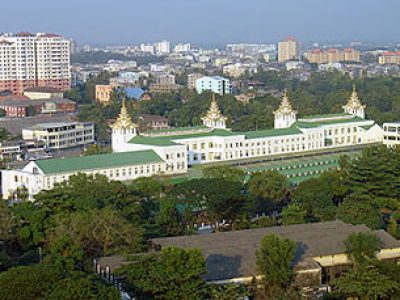
In 1583, Gasparo Balbi “came to the faire cities of Dagon, it is finally seated, and fronted towards the south-west, and where they land are twenty long steps, the matter of them is strong and great pieces of timber–After we were landed we began to go on the right hand is a large street about fifty places broad, in which we saw wooden houses gilded, and adorned with delicate gardens, after their custom, where in Talapoins, which are their Firers dwell. The left side is furnished with Portals, and Shops, very like the new Procuration at Venice; and by a street that go towards the Varella, for the space of a good mile straightforwards either under paint houses or in the open street, which is free to walk in.”
Ralph Fitch wrote about the same time; “It is the fairest place, as I suppose, the that is in the world; it (the Pogoda) standeth very high, and there are four ways to it, which all along are set with trees of fruits, in such wise that a man may goes in the shade above two miles in length. And when their feast day is, man can hardly passe by water or land for the great presse thither of people; for they come from all places of the Kingdom of Pegu thither at their Feast.”
By the end of the 16th century the Shwedagon Fair was attracting people not only from Myanmar but also from distance lands such as Laos and Cambodia. The Dagon Fair was one of the chief markets for overseas trade rivalling Bago and Thanlyin.
The Delta was effecting yet another change. The Bago River too was silting up off Thanlyin, and sea-going vessels were finding it difficult to navigate the reaches opposite the town. Thus, Dagon was becoming the port of choice.
After the founding of the Shwedagon Pagoda. Alaungpaya’s conquest of lower Myanmar is the second most important event in the history of Dagon. May 1775 marks the beginning of the modern town when Alaungpaya, to commemorate his victory, changed its name from Dagon to Yangon, “Enmity Exhausted.”
Alaungpaya’s Yangon was basically a log fortress, with the river frontage in the south, the site of the present 30th street in the west, a line of about 3300′ cutting across the modern Maha Bandola Garden, Pansodan and Bo Aung Gyaw street in the north, and Theinbyu Street in the east. The town lay well to the east of the Sule Pagoda. Its area could not have been more than 1/8 square mile.
The stockade was built of solid teak piles, rising to a height of twelve feet on average, but to twenty feet in some places. The stockade was protected by a ditch and it did not stand directly on the bank of the river but twenty or thirty yards away at its nearest point.
The town had three streets running east-west and two running north-south. The east-west streets counting from the river side were Strand Road, also known as Kaladan, the street of the foreigners because most foreigners lived there. then above that was where modern Merchant Street runs, also known as “Pegu Palace” to the English because the Myowun’s residence was there. The northernmost street was the Mingala Bazaar. The main south-north road ran along the line of the present Seikkantha Street.
The Sule Pagoda stood on a small laterite pinnacle cut off from the town by a swamp. Yangon itself too stood on a small island surrounded by water at high tide, In 1782, it was reported that the streets were not paved but by1795 they were well paved, and because wheel traffic was not allowed within the town, the paving remained in tolerable repair.
Outside the town were three wooden wharfs, the principal one being the King’s Wharf which allowed ships to load or unload without the use of sampans. Higher up the River, beyond the limits of the town, was the China Wharf where Chinese merchants conducted business.
Apart from construction, the shipyards did a busy trade in refitting ships. The industry became so important that it alarmed the British in India who felt that steps should be taken to curb its power, which they did. The East India Company’s government sent a combined force of nearly eleven thousand men with forty pieces of artillery. The transports carrying this force were escorted by HMS Liffey, HMS Larne, HMS Sophia, the sloop Slaney, several cruisers, twenty gun brigs, twenty tow-boats each armed with an eighteen-pounder gun and the steamship Diana. On 10 May 1824 the fleet stood into the River and anchored within the bar. The expedition landed on the 12th The invading force was distributed in the town and along to two roads leading to the Pagoda, along the road-side and on the Shwedagon platform.


In November, the great Myanmar general Maha Bandoola arrived in the neighbourhood of Yangon. He made several attempts to evict the invading force stationed on the Pagoda but was frustrated by the guns of the enemy fleet. On the 15th, the Myanmar army was driven from its stronghold at Kokine. The Myanmar army retreated towards Danubyu where an enemy shell killed Maha Bandoola. That was virtually the end of the war. The Treaty of Yandabo was concluded on 24th February 1826.Yangon remained in occupation till 8th December. The invading force enshipped on 9 December with a detachment left behind to receive the final instalment of the indemnity. Yangon was returned to the Myowun by General Campbell.
Serious damage was done by the troops who pillaged the pagodas on the Shwedagon platform and around the town. A single company stationed on the Pagoda obtained in one night a large number of gold and silver images which was sold to an officer who resold them for a big profit in Calcutta. Most seriously, General Cambell ordered the piercing of a tunnel into the bowel of the Shwedagon in the hope of finding treasure. He was disappointed. Singu Min’s great bell was seized, but when they tried to transport it to India the Bell sank to the bottom of the River. Later, Myanmar people retrieved it by attaching it to a ship at low water, when the tide came in, the ship lifted the bell.
In , King Thayawady decided that King Alaungpaya’s town was too vulnerable to attack from the river and that a new town should be built further inland, about a mile and a quarter from the river. A mud wall sixteen feet high and eight broad was to surround the town and a ditch to run alongside it. The Pagoda was worked into the defences of the town which was about three-quarters of a mile away. Thus the Shwedagon formed the north-east corner of the town. The east border of the town ran along Shwedagon Pagoda Road ridge. The southern boundary was slightly south of the road where the National Health Laboratory now stands. The west road ran roughly along Myoma Kyaung Lan, while the north face cut across Pyay Road and People’s Park. Water was supplied by thirty wells. The town was named Aung Myei Aung Hnin, “Victory Soil, Victorious Ejector”. Endawya Pagoda in Myoma Kyaung lan remains from the visit of Ling Thayawady. Though King Thayawady’s town was occupied for residence, the old Yangon continued to be populous. Commerce and industry and all connected with trade and the port were still situated there. A crane was placed at the new King’s Wharf at Lanmadaw. So King Alaungpaya’s Yangon continued to be the business town. In the end,King Alaungpaya’s town existed for only ten years because by the war of 1852, Lower Myanmar was annexed by the British and a new Yangon was planned. A British force of 6000 men with thirty-five pieces of artillery, escorted by fifteen warships appeared at the mouth of Yangon River on the 1st April 1852. Posts and stackade guarding the River were attacked and taken on the 5th.On the 11th the ships crossed the bar and took up position opposite the old town. The next day, Theinbyu, “the White House Stackade” was taken. Meanwhile, a certain Mr.C.M.Crisp, a foreigner residing in Yangon, who had previously sent information about the defence of Yangon, had told Capital Latter that it would be better to direct the attack at the eastern entrance of the Pagoda which was very inadequately defended. A detachment then rushed the east entrance and gained the Pagoda platform. Myanmar forces were compelled to retire by the southern and western gates of the town. The British lost sixteen killed and one hundred and thirty-three wounded. Two majors also died. The British annexed lower Myanmar by a proclamation dated 20th December 1852. On the 21st the proclamation was read in Yangon.
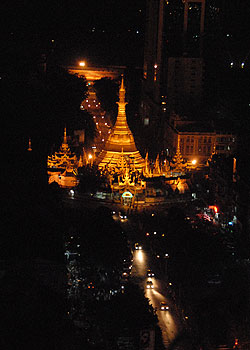
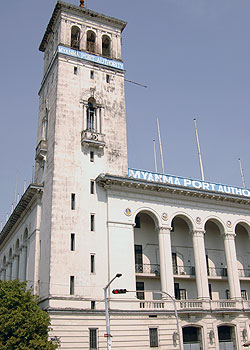
Dr. William Momtgomery who had come along as Superintendent Surgeon with the British troops proposed a town with a checkered pattern of streets based on a road which ran along the Strand. Lt. Fraser of the Bengal Engineers, who had been assigned the design task, largely followed Dr. Montgomery’s plan. Fraser’s detailed proposal dealt with the problem of flooding at high tide. However, his plan had to be modified to provide for a larger city. Three kinds of roads were incorporated into the design. Roads running west to east were broad roads 160 feet wide. Roads running south consisted of two small 30 feet wide roads, one medium-sized road 50 feet wide, two more 35 feet wide roads and then one broad 100 feet wide road. This order was repeated from west to east. The smaller roads were numbered, while the medium and broad roads were given names, some for eminent persons of that time.
As laid down, there was the 100 feet wide Lanmadaw Road, followed by 17th and 18th street, which were small roads, then the medium 58 feet road Sint-O-Dan Road, next the smaller 19th and 20th streets, followed by 100 feet wide Latter Road, followed again by the two numbered small roads 21th and 22th streets.
The roads running paralle west to east were the Strand Road, Merchant Road, Dalhousie Road (Maha Bandoola), Fraser Road, (Anawrahta) and Montgomery/ Commissioner Road (Bogyoke Aung San) then a medium 50 feet wide road known as Bank Road.
Yangon, which had become the model city in South-east Asia, suffered great damage during the Second World War. Its buildings, roads and drainage systems were destroyed. Multicoloured insurgents added to the problem after Independence in 1948. This led to a massive influx of refugees into the city where enough housing was not available to accommodate them. People simply settled where they pleased. The city was now covered with small shacks of bamboo and thatch causing serious fire hazard. Drainage was blocked with refuse. Traffic on motor roads and sidewalks was impeded by huts and shops. People squatted on public land, gardens and parks. Disease became rampant and the mortality rate increased .Fires often broke out, destroying thousands of homes in the squatter slums.

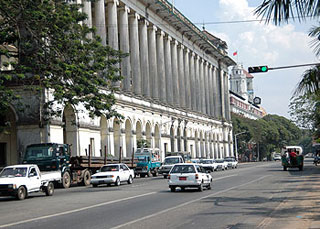
The population was 46000 in 1856; in 1860 it rose to 60,000 To accommodate the population, the original town was extended west by the three 100 feet roads, three 50 feet roads and twenty-two 30 feet roads. The extension to the east was by three 50 feet roads and twenty-two 30 feet roads. The extension to the east was by three 30 feet roads. In 1872, the population had risen to nearly 100,000. In 1900, it was over 200,000. The suburbs of Kyimyindaing, Ahlone, Pazundaung, Yegyaw, Myaynigone, Kamayut were incroporated into the town and Voyle Road (U Wisara Road) was added as another northward road to the existing Prome Road (Pyay Lan).
Meanwhile, British officers and soldiers fallen in the war were buried in the north-east corner of the Shwedagon Pagoda platform. They were exhumed and buried in the Cantonment Cemetery after repeated appeals, only in January 1929.the western stairs were opened to the public in March, 1930, after 77 years in British military custody.
In1869, presiding monk U Pya and elders responsible for the upkeep of the Pagoda found the 100-year old King Hsinbyushin htee crowing the Pagoda had rusted and was beginning to crumble. Since the people of occupied Lower Myanmar could not by themselves put up a new htee, permission was sought and received from the British authorities to appeal to King Mindon who granted assent.
When the htee was ready for crowning, the British began to have serious doubts over the political implication of a Myanmar King embellishing the Shwedagon because the act could signify the King’s supremacy over the area. The British Chief Commissioner of British Burma and not by the Myanmar king. King Mindon agreed. The htee should be placed on the Pagoda by the subjects of British Burma and not by the Myanmar king. King Mindon agreed. The htee was sent to Yangon and was disembarked on 24 October 1871. The vane surmounting the htee was placed in position on 26 November and the ceremony was completed without the trouble the British feared, though people from all parts of the country had flocked to Yangon. “The town was never more quiet as regards crime than during this great influx of people”, reported the Chief Commission. When the Caretaker Government assumed power in 1958,a Municipal commissioner was appointed with the mission to clean up the City. The task was to educate the public, to lay down necessary controls, to dredge and clear blocked drainage, to rid sidewalks of encroaching shops, to repair old equipment and install new machinery. the mission was undertaken with the slogan; “Wash the City with sweat.”
People living as squatters on public land and in trespassing huts, and those living on roadsides were transferred with necessary help to the new towns of Thaketa, South and North Okkalapa. At first, people were reluctant to move, but when they found themselves living in their own houses in clean quarters with water and electricity, good roads and health and educational facilities they realiz ed how well they had come up in life from their previous squalid habitats.